|
This glossary will be updated
continuously.
Cumulative Impact Assessment -
Evaluating Cumulative Effects
This is not a specific tool - but an approach aimed
at enhancing the quality of EIAs, SEAs and other such processes. The
objective is to ensure that any assessment process takes a full view of ALL
the developments which might be taking, or planned to take place, within an
area of influence - both as a result of the proposed development under
specific investigation, or independent to it.
EMPRs
Environmental Management Programme Reports for
prospecting and mining. This is a process developed specifically for the
mining industry - to provide guidelines for the development, management, and
ultimate closure of mining operations. the primary objective lies in impact
mitigation. EMPRs were developed by the Department of Mineral and Energy
Affairs.
Environmental Impact Assessment (EIA)
EIA is a project specific process which looks at how
a proposed development might impact on the environment, and at how those
impacts might be mitigated. The EIA is an extremely important and useful
tool in South Africa - and the primary legislative check on most forms of
development - a check which also allows for the shaping of the development
to be more environmentally acceptable. The completion of an EIA is a legal
requirement for many types of development project including all forms of
land transformation, such as conversion of natural veld to agriculture or
forestry. A good EIA will also give consideration to alternative ways in
which the land or resource could be used.
The Department of Environment Affairs has the statutory authority to apply
EIA to all development, through the National Environmental Management Act
(NEMA).
Environmental Management Frameworks
(EMFs)
The EMF is a spatial inventory, essentially a filing
system of information, with a strong focus on biophysical parameters.
Specific environmental management parameters are connected to this
information. The national Department of Environment Affairs and Tourism
(DEA&T) is in the process of establishing Environmental Management
Frameworks for each province. These EMFs are environmental databases
providing the information for use in the formulation of management plans.
SEAs form a most valuable component at this part of the loop. The EMFs
provide a useful gathering of data, which can then readily be made available
to provincial planners. Such data will include physical and environmental
coverages (such as topography and land cover). Social and economic data
available through sources such as the national census would also be
included. As with SEAs the EMFs aim to pro-actively identify areas of
potential ‘conflict’ in land use, with the emphasis on environmental
opportunity. The EMFs are databases of concrete information and do not offer
tools, weights, or pictures of visions or understanding.
Integrated Environmental Management
(IEM)
IEM has become the umbrella term, or toolbox, within
which all environmental assessment processes, and environmental management
practices, reside. IEM has become a guiding philosophy - the interface for
the various environmental management processes. IEM is the umbrella covering
EIA, SEA and EMPs (Environmental Management Planning).
State of the Environment (SOE)
This is an information gathering and reporting procedure
providing a report on the current state of the environment. An SOE report
sets a baseline but aims also to explain causes (past and present) and
effects (present and future). It serves as a useful decision making and
management aid. In South Africa SOE reports are currently being undertaken
at national and at city level.
Strategic Environmental Assessment
(SEA)
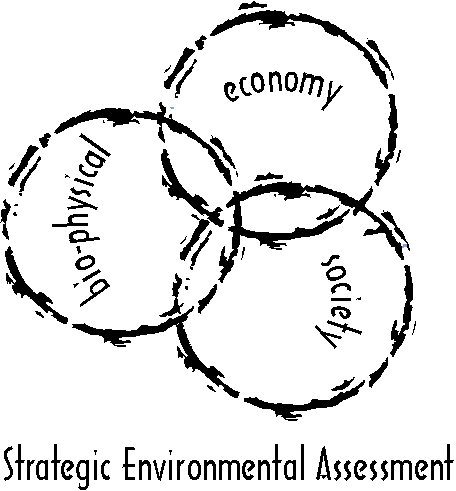
SEA is a far-reaching and proactive process, differing
fundamentally from EIA in a number of ways. DEA&T does not have a
mandate to implement or apply SEA. Indeed there is no legal requirement for
SEA but SEAs are more and more frequently being undertaken voluntarily by
Provinces and by Government as a process toward sound land use planning and
management. SEA looks at the whole environment and reviews how that
environment can support development, ie what fits with what the environment
has to offer, and can be practised in a sustainable way. SEA looks not only
at the physical environment, but also at the social and economic context. An
SEA will gather information, seek to describe opportunities and constraints,
deal with issues and work with stakeholders at all levels. Much of the
information which an SEA seeks to gather is unique to the process - for
example the demands, needs and visions of stakeholders, an understanding of
true social and economic dynamics, prosects for alternatives, and the way in
which this information is brought into debate and ultimately made available
to both developers and decision-makers, so that choices can be made and
decisions understood. A table listing the differences between EIA and SEA is
attached - but in reading the comparison it should be remembered that both
tools have their place and offer complementary services in environmental
management. Indeed a good SEA should provide answers to many of the
questions facing an EIA, where these may apply to a region or catchment, and
it is the intention of the SEA process to simplify any required EIA by being
pro-actively ready with knowledge and data
Any SEA also relies heavily on data - and the EMF can be
seen as a good springboard. The SEA builds on EMF and other data to provide
a more complex product. In the first instance an SEA is not limited to hard
or ‘factual’ data. It may use hard data in attempts to understand and
describe an area, situation or landscape, but does not stay limited to this
data only. SEA does not only provide data (strictly the role of the EMF) but
offers tools for decision-making, ways of weighing up information in its
very many forms, and at all scales of influence, for the guiding of
decisions. One key difference is that SEA also attempts to capture the way
people are thinking, the visions, ideals, needs and demands of the different
stakeholders. There is extensive consultation. Through this participation
roleplayers assist in identifying, or are otherwise made aware of,
opportunities and constraints, and of the nature of information and issues
driving decision-makers. SEA requires to look at different forms of land use
and to consider whether such use would be (a) acceptable (b) the best
possible way of using the resource, and (c) sustainable. In an SEA the
process is often considered more important than the product, and this too is
one of its defining features. SEA is not a planning exercise - but offers a
process, and information from which planning can be generated.
The Department of Water and Sanitation has embraced
the concept of SEA as a tool for use in catchment planning and management,
and as a support to the National Water Act.
Strategic Environmental Management
Planning (SEMP)
Here too there may seem to be overlap with the SEA
process, particularly in Mpumalanga where the SEMP process is well advanced.
The SEMP is a management plan. It is not strictly spatial (like the EMF) but
also includes policy and process issues. The SEMP will take the spatial
inventory (provided by the EMF) and, based on extant conditions will look at
possible sustainable futures. An Environmental Impact Assessment (EIA) will
usually result in an Environmental Plan (EMP). So too we can see an SEA
resulting in a Strategic Environmental Management Plan (SEMP). This is
because the SEA is not a planning process but does provide useful
information to planners. The SEMP is a Strategic Plan, generally offered at
the scale of the province. SEMPs provide the framework for more site
specific studies. SEMPs tend to be broad and may lack, as in Mpumalanga,
much of the conflict and visions data which the SEA for SFRAs is providing.
There is a good deal of synergy between these processes.
SEMPs are also an important tool in providing the
over-arching environmental management system for development clusters or
nodes. For example, a SEMP would provide the environmental limits and
guidelines for the establishment of an industrial park in which various
different companies may be setting up. Typically a SEMP was proposed for the
Coega Industrial Zone (Eastern Cape), and a similar framework was prepared
for the Capricorn Industrial Park (Western Cape).
Stream Flow Reduction Activity (this
is the present working definition)
An SFRA is any dryland land use practice, which
reduces the yield of water (with reference to yield from natural veld in
undisturbed conditions) from that land to downstream users. Such activities
may be declared as SFRAs if found to be significant.
|