|
|
|
|
|
 |
TREES OF THE YEAR 2006 |
|
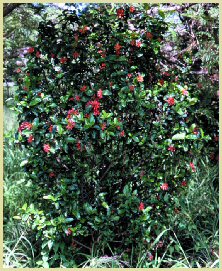
 Common Tree: Wild Pomegranate Common Tree: Wild Pomegranate
National Tree Number: 688
Botanical name: Burchellia bubalina
Other names: Wildegranaat, isiGolwane, umFincane
Description:
Shrub or small evergreen tree 3 to 5m
in height but occasionally reaching 10m.
The Wild pomegranate is widely propagated
as ornamental garden tree for it is attractive
at all times and beautiful when in flower. Although
slow growing, it is easily propagated from seed or
cuttings. The showy flowers of the tree (which appear
from September to December) contain copious
amounts of nectar, and are pollinated by birds. The
genus Burchellia was named after the traveller and
botanist, William Burchell.
|
Photograph: NBI/The DWAF
|
|
| |
|
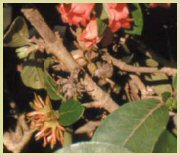
The bark is grey, mottled, smooth.
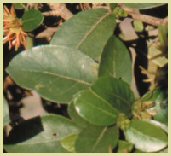
The leaves are broadly ovate, 50-180 x 25-80 mm,
glossy dark green.
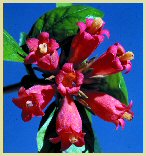
The flowers are orange to dark red in colour, tubular in
shape and occurring in dense terminal clusters. The fruit is urn-shaped, rather leathery, about 1 to 1.5cm
long, reddish-green to brownish, crowned with persistent
horn-like enlarged calyx lobes.
The wood is hard, dense and closed-grained.
|
| |
| |
|
| |
Uses:
The roots provide an infusion which is taken
as an emetic and used as a body-wash. The wood is
used for hut-building and the making of agricultural
implements. The wild pomegranate has become
increasingly popular as a small ornamental garden
tree.
Distribution:
It occurs in the high rainfall areas of
the eastern parts of the country, mainly in evergreen
lowland to montane forest and at the margins of forest,
but occasionally also in woodland, grassland in
rocky outcrops and also in swamp areas.
|
Rare Tree: Kosi Palm
National Tree Number: 26
Botanical name: Raphia australis
Other names: Kosipalm, Umvuma
Description:
A massive palm up to 24m high, erect
stem, not suckering, usually with breathing roots
growing up from the soil below the tree. It flowers
once after about 30 years, sets fruit and then dies.
A magistrate at Mtunzini planted a
grove of Kosi palms just after the turn of the century,
and later their spread in this area was encouraged
by an offi cial employed in malarial control who, in
the course of his work, planted seeds wherever he
thought the conditions suitable for the plants, and
they all germinated and prospered.
The bark is thick and overlapping scales.
The leaves are pinnate and feathershaped,
very large, up to 10m long, spreading,
dark green to bluish green, leaflets with margin and
midrib spiny.
|
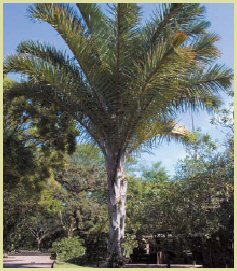
Photograph: NBI/The DWAF
|
|
| |
|
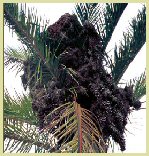
The flowers are in a massive, up to 3m high,
conical, apical inflorescence above the crown of
leaves.
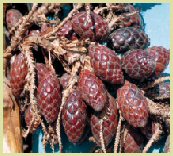
The fruit is oval, about 90mm long, shiny brown.
The inner trunk does not consist of solid
wood, but is fibrous in texture.
|
| |
| |
|
| |
Uses:
The leaves of the Kosi palm are used as a
thatch material, and the petioles for hut construction,
outriggers for canoes, fences and rafts. The trees
are vital for the survival of the rare Palm Nut Vulture.
Distribution:
The Kosi palms occur naturally in the
north-eastern extremity of Kwazulu Natal and in
southern Mozambique, where they are usually found
in swamp forest, often in dense groves. As the name
indicates, the palms are mostly found in the vicinity
of Kosi Bay, but some trees became naturalised further
south up to the Mtunzini area. Palm nut vultures
(Gypohierax angolensis) nest in the trees and feed
on the fruit.
|
| |
|
|
|
|
|