|
|
|
|
|
 |
TREES OF THE YEAR 2000 |
|
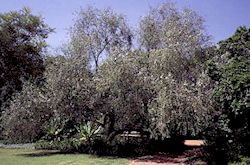
 Wild willow (Safsaf Willow) Wild willow (Safsaf Willow)
National Tree Number:
Other names: Salix mucronata, Mogokare,
um Nyezane,
Wilde wilger (Safsafwilger)
Description:
This semi-deciduous to evergreen found along riverbanks. Grows up to 15 metres with an open crown and drooping branches. Can withstand frost and drought. Propagation more rapid if cultivated from cuttings or truncheons but seeds may also be sown in trays filled with river sand.
|
|
|
| |
|
Main stem: Fissured brown bark on older trees, smooth and green-red on younger trees.
Leaves: Simple, alternate, tapering to both ends, dark green above and lighter below, margins serrated.
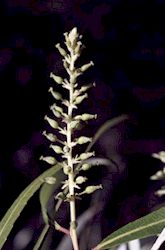
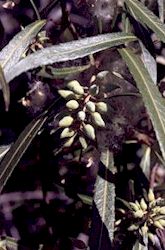
Flowers: Dense male and female spikes, male spikes dens and up to 50 mm long, female spikes shorter and thicker.
Fruit: Capsule, which splits to release seeds covered with white fluff.
|
| |
| |
|
| |
Uses:
Leaves eaten by livestock. Plant truncheons in lines close together
across riverbank to stabilise eroded riverbanks. Also used to protect water sources from
damage caused by animals. Young branches used to make baskets; household items and
carvings made from the wood. Roots used for curing stomach pains, fever and headaches.
Aspirin is a derivative of the willow species, bark powder used to treat burns, tea from
the leaves used for rheumatism and as a mild laxative.
|
African wattle (Weeping wattle)
National Tree Number:
Other names:
Peltophorum africanum,
Mosehla,
isiKhabakhombe,
Nhlanhlanhu,
Ndedeze,
Mosathla,
Musese,
Huilboom,
isiKhaba-mkhombe,
umSehle,
umThobo
Description:
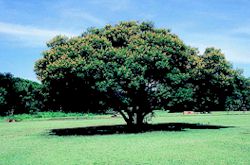
Semi-deciduous to deciduous tree of about 15 metres with a spreading, untidy canopy. Grows best in well-drained soils. To propagate, place fresh seed in hot water and leave overnight. Sow in a 5:1 mix of riversand and compost. Fast growing and drought resistant. Frost tender for first tree years.
|
|
|
| |
|
Main stem: In older trees, the bark is grooved and grey-brown, the bark of younger trees is smooth and grey.
Leaves: Acacia-like and silver-grey covered with fine hair, mature leaves yellowish at tip of branches, twice compound with a pair of leaflets at the tip, alternate, up to nine pairs of pinnae each with 10 to 20 pairs of leaflets. Leaf, stalk and rachis covered with reddish brown hairs. No thorns.
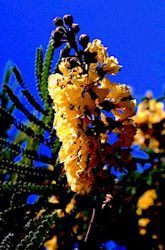
Flowers: Upright showy sprays (15 cm long) of bright yellow flowers with crinkled petals on the ends of branches, stalk covered with reddish brown hairs.
Fruit: Clusters of thin, flat dark brown/black pods of about 10 cm, tapering to both ends.
|
| |
| |
|
| |
Uses:
Young leaves and pods eaten by livestock. High yield of nectar and pollen for bee keeping. Timber used for furniture and fuel. Good shade tree. Roots used to heal wounds, toothache and throat sores. Roots, leaves and bark used to clear intestinal parasites and relieve stomach problems; bark relieves colic, stem and root used for diarrhoea and dysentery. Also used to treat eyes.
|
| |
|
|
|
|
|