Arbor Week
    SEARCH
22-May-2009 12:21 PM  
2004 Home
Trees of the Year
Articles
Posters
alt
Events
Contacts
bullet

TREES OF THE YEAR 2004

Common Tree: Hiccup Nut

National Tree Number:
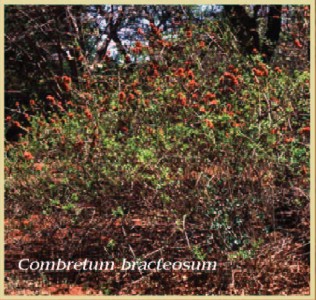
Botanical name: Combretum bracteosum
Other names: Hikklimop (Afrikaans), Uqotho (Xhosa)

Description:
A small to medium sized tree, 3 to 10m in height, occasionally bushy and shrub-like.

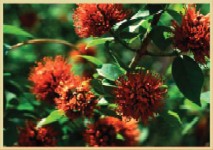
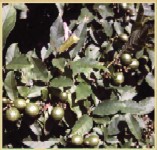
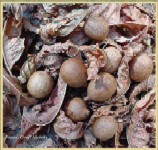
The bark is grey to dark grey or brownish-grey and is smooth becoming scaly and rough with age. The leaves are opposite, narrowly to broadly obovate-elliptic, oblong or broadly ovate, 3 to 13 X 1,5 to 8cm thinly leathery. Young leaves are sticky and glutinous with a varnished shine. Two types of flowers are produced, yellow to creamy-green or red, and are heavily scented. They have auxiliary spikes and grow up to 7 X 1,5 cm. Flowering occurs during September to February. The fruit are oval reddish-brown when mature. Fruiting occurs during January to May. Old fruit may be present until October.


Photograph: NBI / The DWAF


Uses:
A decoction of the leaves can be used as a steam bath and also as an enema to relieve stomach disorder.

Distribution:
It occurrs in dry open woodland at medium to low altitude and in dune forest, especially the eastern coast of South Africa.


Rare Tree: White Seringa

National Tree Number:
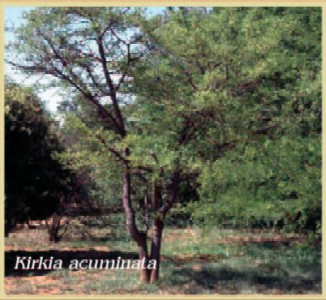
Botanical name: Kirkia Acuminata
Other names: Witsering (Afrikaans), Modumela, Mvumayila

Description:
A deciduous straight-stemmed tree up to 20 metres in height, found in open dry woodland and rocky hill slopes and always on sandy or alluvial soils.

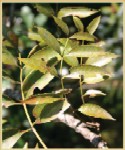
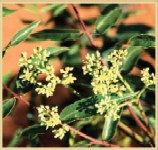
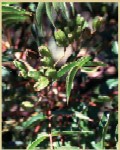
It is a straight stemmed tree. The bark is grey, smooth when young and rough with age.The leaves are bunched at the ends of branches, alternate, unevenly compound with a single leaflet at the tip. Leaves are 200 - 400mm long and turns an attractive red color in autumn. Flowers are small greenish-cream, produced in many branched but rather lax heads up to 7cm long in the axils of the leaves. Flowering occures from October to November. The fruit is small and light brown, four valved capsules. Fruiting occures from January to April and onwards.


Photograph: NBI/The DWAF


Uses:
The tree is sacred to some communities and are therefor protected by them. It is an ideal garden and street tree and can be used as a fence. The roots can easily be tapped for water and the powdered root is used as a remedy for toothache.

Distribution:
It occurs mainly in the Mpumalanga and Limpopo provinces of South Africa, also in Botswana, Tanzania, Zimbabwe and Mozambique.


bullet


bullet


[top]
This site is best viewed using 800 x 600 resolution with Internet Explorer 4.5, Netscape Communicator 4.5, Mozilla 1.x or higher