|
|
|
|
|
 |
TREES OF THE YEAR 2009
|
|
 Common Tree: Monkey Thorn Common Tree: Monkey Thorn
National Tree Number: 166
Botanical name: Acacia galpinii
Other names: Tshikwalo (Tshivenda), Apiesdoring (Afr.), Molopa (North Sotho)
Description:
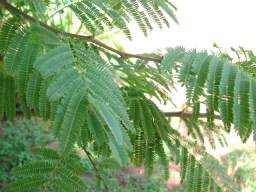
Acacia galpinii is a deciduous tree, losing its leaves during the southern African winter (April-July). It is fast-growing and can reach 25-30 m. Creamy to light yellow flowers appear during the growing season (September-October). Reddish to purplish brown pods ripen during February-March. Acacia galpinii is often confused with Acacia polyacantha from which it can be distinguished by the gland on the leaf stalk: small in A. galpinii and large in A. polyacantha.
|
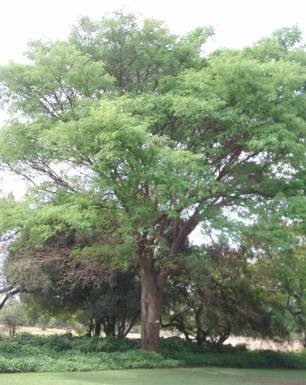
Photograph: NBI |
|
| |
|
The name Acacia is derived from the Greek word 'akis', meaning a point or a spike, referring to the thorns in many Acacia species. The South African species are armed with spines. Most of introduced species from Australia are spineless. The species was named in honour of Ernest Galpin (1854-1941), a plant collector. Monkeys like taking cover in its wide branches and may also eat the pods and seeds, hence the common name.
There are about 1 340 species in this genus of which 954 are indigenous to Australia, 230 to the Americas, 129 to Africa and some species scattered in Asia. This very large, pan-tropical genus occurs mainly in dry country.
|
| |
| |
  |
| |
Uses:
Many insects such as bees and wasps visit the flowers. Ripe fruit pods burst open, releasing the seeds. Seeds are also dispersed by animals eating the pods.
Acacia galpinii is one of the trees that can survive hot and dry conditions. It makes a stunning tree along roads where there is enough space. It is an ideal tree for a big garden. In the wild the plant is grazed and used for shade during the hot summer by different animals including giraffe, kudu and elephant. Many birds often prefer nesting in this tree as it provides protection. It provides dappled shade on hot summer days, making it an ideal tree for planting on a lawn where some sun can penetrate.
Distribution:
Monkey-thorn grows naturally in open, wooded grassland, open woodland and often near streams. It is indigenous to Zambia, Zimbabwe, Malawi, northern and eastern Botswana and South Africa. In South Africa, Acacia galpinii occurs naturally in Limpopo [Northern Province] and the North-West. It is seen as an indicator of sweet veld, which retains its nutritional value in winter.
|
| |
| |
| |
|
Rare Tree: Tree Fuchsia
National Tree Number: N/A
Botanical name: Halleria lucida
Other names: Notsung (A), umBinza (X)
Description:
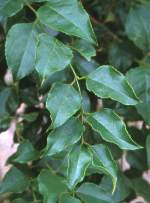
Not only is Halleria lucida an attractive tree and an asset to any garden, it is also one of the best bird attracting trees. It is an evergreen tree or large shrub, often multi-stemmed, with a spreading crown and attractive glossy bright green foliage on arching and drooping branches.
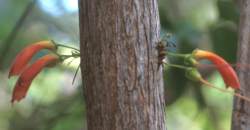
The bark is longitudinally grooved and pale grey and brown in colour. The flowers are tubular, orange to brick-red, or yellow, very rich in nectar and are produced in clusters in the axils of leaves and on short shoots on the old wood, even on the main trunk. When in full flower in autumn to summer (May to December/January) it can be very showy, although the flowers are somewhat hidden amongst the leaves and inside the canopy.
|
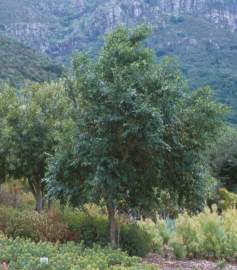
Photograph: NBI |
|
| |
|
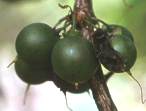
Clusters of 10 mm diameter spherical green berries that turn juicy and black when ripe, follow the flowers (August onwards). These are edible, but never tasty, not even when ripe. They have a sickly sweet taste and tend to dry the mouth. The seeds are very small black flakes in the jelly-like flesh of the fruit.
|
| |
|
|
| |
   |
| |
Uses:
The Zulu nation has a strong belief in traditional medicine and they use Halleria lucida for skin and ear complaints. Dry leaves are soaked in water and squeezed into the ear to relieve earache. This tree is also considered to be a charm against evil. The twigs are burnt when offering sacrifices to the ancestral spirits. The plants are set alight each year, the ashes mixed with crocodile fat and this mixture is smeared onto cuttings of Rhamnus prinoides which are then driven into the ground around the village to protect the community from wizardry and lightning. The wood can also be used to start a fire by friction. Halleria lucida timber is light coloured tinged with yellow, hard, heavy and strong, well suited to carpentry, but is not much used because the pieces are small. It was once valued for wagon poles, tools and spear shafts.
Distribution:
Halleria lucida is found in coastal and karroid scrub, deep evergreen forest, forest margins, forested ravines, rocky mountain slopes, near rivers and on stream banks from the Cape peninsula in the south in a strip up the eastern coast of South Africa, through the Eastern Cape to Lesotho, the eastern Free State, KwaZulu-Natal and Swaziland where it turns inland and roughly follows the escarpment into Mpumalanga, Gauteng and the Northern and North West Province. It also occurs in isolated pockets in Zimbabwe. In the more exposed situations it is generally a stocky or shrubby tree that reaches a height of 2-5 m but in well watered, protected situations it can reach up to 12 m, and in forests, it can grow up to 20 m in height.
|
| |
| |
| |
|
Rare Tree: Round-leaved Teak
National Tree Number: N/A
Botanical name: Pterocarpus rotundifolius
Other names: Muhataha (Tshivenda), round-leaved bloodwood (Eng.), dopperkiaat (Afr.)
Description:
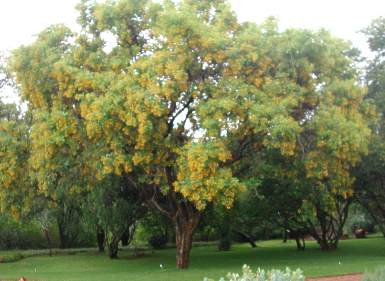
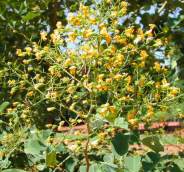
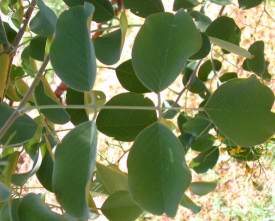
Pterocarpus rotundifolius is a deciduous tree that reaches a height of 10 m, but under ideal conditions it can become even bigger. Deep yellow, pea-shaped flowers appear from September to January. During hot, dry weather the flower buds remain closed and they burst into flower only on wet days, lasting two to three days. A flattened pod with one seed matures from November to April. The tree burns very easily in bush fires.
|
Photograph: NBI |
|
| |
This tree's scented flowers attract many insects like bees and wasps, which play a vital role in pollination. Ripe fruits are often dispersed by wind. Cattle and game browse the young leaves, and birds use it for nesting. Larvae of the bushveld charaxes butterfly (Charaxes achaemenes achaemenes) live on the leaves. |
|
| |
   |
| |
Uses:
It is used as firewood in some parts of Limpopo. In the past it has been used as a general-purpose timber, but the wood is not that durable. It is also a favourite in bee farming as it is a good source of nectar and pollen for honeybees. It is generally a good garden subject. It can be used for providing shade.
Distribution:
In South Africa it occurs naturally from KwaZulu-Natal in the south, through Swaziland, Mpumalanga, Limpopo (Northern Province) to the northern parts of North-West Province. It is also indigenous to Zimbabwe, Malawi and Zambia. It grows in open bushveld and on rocky hillsides, often forming a colony.
|
| |
|
| |
| |
|
|
|
|